Showing posts with label DISHES. Show all posts

Wednesday, June 20, 2012

DIGESTION TIME OF VARIOUS FOODS IN THE STOMACH


DIGESTION TIME OF VARIOUS FOODS 
(approx. time spent in stomach before emptying). ........

UNEDITED  EXTRACTS from DR STANLEY’S ARTICLE ON FOOD HYGIENE link here


Water
when stomach is empty, leaves immediately and goes into intestines,
Juices
Fruit vegetables, vegetable broth - 15 to 20 minutes.
Semi-liquid
(blended salad, vegetables or fruits) - 20 to 30 min.
Fruits
Watermelon - 20 min.digestion time. 
Other melons - Canteloupe, Cranshaw, Honeydew etc. - 30 min.
 
Oranges, grapefruit, grapes - 30 min.
 
Apples, pears, peaches, cherries etc. - digest in 40 min.


Vegetables
Raw tossed salad vegetables - tomato, lettuces, cucumber, celery, red or green pepper, other succulent vegetables - 30 to 40 min. digestion. - 
Steamed or cooked vegetables
Leafy vegetables - escarole, spinach, kale, collards etc. - 40 min. - Zucchini, broccoli, cauliflower, string beans, yellow squash, corn on cob - all 45 min. digestion time
Root vegetables - carrots, beets, parsnips, turnips etc. - 50 min.


Semi-Concentrated Carbohydrates - Starches
Jerusalem artichokes & leafy, acorn & butternut squashes, corn, potatoes, sweet potatoes, yam, chestnuts - all 60 min. digestion. 
Concentrated Carbohydrates - Grains
Brown rice, millet, buckwheat, cornmeal, oats (first 3 vegetables best) - 90 min. 
Legumes & Beans - (Concentrated Carbohydrate & Protein)
Lentils, limas, chick peas, peas, pigeon peas, kidney beans, etc. - 90 min. digestion time 
soy beans -120 min. digestion time
Seeds & Nuts
Seeds - Sunflower, pumpkin, pepita, sesame - Digestive time approx. 2 hours.
Nuts - Almonds, filberts, peanuts (raw), cashews, brazil, walnuts, pecans etc. - 2 1/2 to 3 hours to digest.


Dairy and dairy products
Skim milk, cottage or low fat pot cheese or ricotta - approx. 90 min. digestion time 
whole milk cottage cheese - 120 min. digestion
 
whole milk hard cheese - 4 to 5 hours digestion time
 
Animal proteins
Egg yolk - 30 min. digestion time
Whole egg - 45 min.
 
Fish - cod, scrod, flounder, sole seafood - 30 min. digestion time
Fish - salmon, salmon trout, herring, (more fatty fish) - 45 min. to 60 digestion time
 
Chicken - 1½ to 2 hours digestion time (without skin)
 
Turkey - 2 to 2 ¼ hours digestion time (without skin)
 
Beef, lamb - 3 to 4 hours digestion time
 
Pork - 4½ to 5 hours digestion time
 

(Editor's notes
Note1:
 raw animal proteins have much faster digestion times than the above times for cooked/heated animal proteins.

Note2: The digestion times given are under an
 ideal situation of eating only one food, chewing well, and having efficient digestion, as is the case e.g. after a fast. They are digestion times for optimally healthy persons, with good eating habits. The digestion times are to a large part derived from Dr. Gian-Cursio's and Dr. Bass' practices.
Digestion times are much longer on a conventional diet, and for persons with non-optimized digestive systems, or persons lacking in energy, and for meals with many ingredients put together haphazardly = not in the optimum sequential order
.)

FROM DR STANLEY 
..... In my opinion and experience as a nutritional consultant in Natural Hygiene (I began studying nutrition in 1936), sequential eating represents the most advanced approach to understanding proper food combining.
After testing and retesting the concept on myself thousands of times, as well as on others, including the experience of Dr. Cursio, his family, his patients, as well as other Hygienic doctors - Dr. John Mega, Dr. Marvin Telmar, Dr. Anthony Penepent, etc. 

FOOD COMBINING
Any quick digesting foods must wait till the slowest digesting foods leave the stomach before they can leave - a process which can take up to 6 or 8 hours. While waiting, the fruit, cooked and raw vegetables, and some of the starches undergo some decomposition and fermentation, producing gas, acid and even alcohol along with indigestion. .....

BASIC RULE - WATERY FOODS FIRST
Eat the most watery food first .....
Avoid drinking beverages or even water during or after meals
Chew your food as close to liquid form
My earlier post on sequential eating-   link here

Try it - feel the difference when you practice "sequential eating"
(eating in layers/ proper combination of foods).

Saturday, May 26, 2012

POULET YASSA -CHICKEN RECIPE FROM SENEGAL. WEST AFRICAN COOKING.

WEST AFRICAN COOKING AND TRADITIONS

POULET YASSA -CHICKEN RECIPE FROM SENEGAL

African cuisine is a term collectively referring to the cuisines of Africa, second largest landmass on Earth. It is home to hundreds of different cultural and ethnic groups- hence a diversified culinary tradition in terms of choice of ingredients, style of preparation and cooking techniques.
The continent's many populations: Central Africa, East, North and South and the Horn of Africa each have their own distinctive dishes, eating and drinking habits.
THIS POST IS PART IV OF A FOUR PART SERIES- WEST AFRICAN COOKING
Part 1- link here  East Africa
Part 2- link here  North Africa
Part 3-  link here  South Africa
West African cookingSenegal, Ivory Coast, Nigeria, Ghana, Sierra Leone, Benin, Gambia
A typical West African meal is heavy with starchy items, meat, spices and flavors. A wide array of staples are eaten across the region, including those of Fufu, Foutou, Banku, Kenkey, Couscous,Tô, and Garri which are served alongside soups and stews.
Ingredients like native rice (oryza glaberrima) rice, fonio, millet, sorghum, bambara and housa groundnuts, black-eyed beans, brown beans, and root vegetables such as yams, sweet potatoes, and cassava are popular. 

Many of the dishes are enriched by tomatoes, onions and chili peppers, these are considered essential and "sacred" to the cooking techniques of the region
Flaked and dried fish is often fried in oil, and sometimes cooked in sauce made up with hot peppers, onions, tomatoes and  various spices (such as Soumbala). Water is added to make this into a highly flavored stew. 

Beef and especially mutton are preferred. Seafood, eggs and chicken are also consumed.

Water has a very strong ritual significance in many West African nations (particularly in dry areas) and water is often the first thing an African host will offer his/her guest. Palm wine, a common beverage from the fermented sap of various types of palm trees usually in sweet or sour varieties

Fufu is often made from starchy root 
vegetables such as yams, cocoyams or 
cassava, also from cereal grains like 
millet, sorghum or plantains. 

Klouikloui, rings of fried peanut butter  served in Benin. 
Eat guinea fowl eggs


Rice-dishes are also widely eaten in 
the region, especially in the dry Sahel 
belt inland.
Examples of these include Benachin from the Gambia and 
Jollof rice ( see pic), a pan-West African rice dish, origin of Ghana.

Beef Suya, a trending grilled spicy meat kebab flavored with peanuts and other spices, is sold by street vendors as a tasty snack or evening meal and is typically made with beef or chicken.
The staple grain or starch varies 
between region and ethnic groups. 
Corn is trendy. Banku and Kenkey are 
maize dough staples (left), and Gari is made from dried grated cassavas.


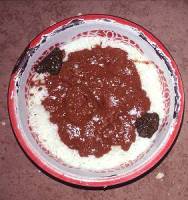
West African Maafe or groundnut stew

prepared by a Senegalese cook


SENEGALESE FOOD
The food of Senegal are very much influenced by the many ethnic groups, the French, Portuguese and those of North Africa. As it borders the Atlantic Ocean, fish becomes a staple, with peanuts as the primary crop. Fresh juices are made- frobissap, ginger.
Buy (pronounced buoy) which is the fruit of the baobab tree tree also known as "monkey bread fruit", mango, or other fruit or wild trees. Desserts are very sweet and rich- the extravaganza of the stylish characteristics of  French culinary. Drinks include coffee and tea.
RECIPE

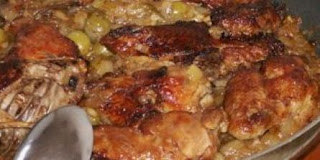
POULET YASSA
A traditional dish of Senegal, Poulet Yassa (Chicken Yassa), is one of the most famous Senegalese recipes. The chicken is marinated overnight. Another variety is Fish Yassa (poisson yassa). For the simplest yassa, just marinade with oil, lemon juice, onions and a little mustard.
What you need
1½ cup peanut oil (or any cooking oil)
One chicken, cut into serving-sized pieces
4- 6 onions, cut up
8 tbsp lemon juice
8 tbsp vinegar (cider vinegar is good)
1 bay leaf
4 cloves minced garlic
2 tbsp Dijon mustard (optional)
1-2 cubes Arome Maggi® sauce (or Maggi® cubes mix with water), or soy sauce (optional)
chili pepper, cleaned and finely chopped (optional)
cayenne pepper or red pepper, black pepper, salt (to taste)
a small cabbage, cut into chunks (optional)
a few carrots, cut into chunks (optional)
What you do
Mix all ingredients (except the optional vegetables), the more onions the better, and allow chicken to marinate in a glass dish in the refrigerator for a few hours or overnight. Remove chicken from the marinade, but save the marinade (ingredients). Cook according to one of the following methods.

Cooking method 1: Grill chicken over a charcoal fire (or bake it in a hot oven) until chicken is lightly browned but not done.
OR
Cooking method 2: Sauté chicken for a few minutes on each side in hot oil in a frypan.

While chicken is browning: Remove onions from marinade and sauté them in a large saucepan  for a few minutes. Add remaining marinade and the optional vegetables and bring to a slow boil and cook at a boil for ten minutes. Cook the marinade into a sauce. Reduce heat.
Sources link  here..  and here  and wiki and other sources.
OSU Castle- government house Ghana
  
Diamond mining  Sierra Leone
 Ghana Silk and cotton woven materials
Fishing boat - The Gambia
Market place- Ivory Coast
Some images of West Africa

Saturday, May 12, 2012

IRISH STEW RECIPE. INDONESIAN ‘SEMUR’ STEW RECIPE. COOKING TECHNIQUES- STEWING and TENDERIZING

IRISH  STEW  RECIPE.  

INDONESIAN  ‘SEMUR’ STEW  RECIPE

COOKING TECHNIQUES- STEWING and TENDERIZING

STEWING
Meat and vegetables cooked together, also known as hotpot. Two main types of stew by Oxford dictionary defination:

1-Brown stew in which meat, vegetables, and flour are fried together before stewing, and
2-White stew in which the ingredients are not fried first. Irish stew is a thin white stew (i.e. not thickened with flour).
In culinary terms 'stewing means slowly cooking food in its own juices with the aid of a minimum amount moistening agent in the form of stock, sauce, butter etc.
Ingredients can include meat, poultry, seafood and vegetables (potatoes / beans) and fruits (tomatoes/ peppers).

During cooking, the liquid is flavored by extracts from the stewed food, the result is a highly flavored sauce. Throughout this long process, evaporation is kept to a minimum by covering the stewing pot with a tight fitting lid and simmering the stew on top of the stove or in the oven.

Condensation, which continually forms on the inside of the lid, acts as a self basting process keeping the food moist. Once cooked, the liquid and food are usually served together to form the complete dish. Stew is thicken by reduction.
Stew may also be thicken by adding thickeners such as cornstarch or arrowroot.

HOW TO MAKE A ROUX
If you feel like thickening the stew, you may add roux. Roux is a mix of 50 / 50 butter and flour, used to thicken the stew or to thicken all sorts of sauces/ gravy.
On a medium heat pan, melt butter, then whisk (or vigorously fork in) the flour for about 2 minutes, do non stop whisking to prevent it roux from sticking on the pan.
wikipedia, wikipedia.org,cookipedia and few other sources

INDONESIAN SEMUR STEW RECIPE

Semur is an Indonesian stew with thick brown gravy. The main ingredient used are shallots, onions, garlic, nutmeg, cloves  and dark soy sauce (sweet soy / kicap manis). Soy sauce is the most important ingredient in the Semur- because it serves to strengthen the flavor.
Variation from beef, the main ingredient, will be tofu, tempe, eggs and potatoes.
Ingredients:
500 grams beef
2 medium size onions
4 garlic cloves
2 large potatoes- quartered
2 large tomatoes- quartered
2 tbsp lemon/ lime juice
4 tbsp dark soy sauce/ kicap manis
2 hardboiled eggs (optional)
Cooking oil

Bumbu mix:

1 tsp ground nutmeg
1 tsp ground cloves
½ tsp cinnamon powder
1 star anise
2 bay leaves (daun salam)
Salt and pepper

Preparation:

Heat up oil and brown the onions. Add garlic and beef until brown. Mix in the bumbu and soy sauce, vinegar and add water enough to cover 3 inches above the beef.
Simmer on a low heat for about 1 hour or until meat is tender. Top up more water if need be, water level should be just about cover the beef. Add  potatoes. After 20 minutes, add tomatoes and eggs. Once tomatoes cooked, put off fire. Done..

Irish stew is classically made with lamb, other than that, there is little difference, really.

IRISH STEW RECIPE
Irish stew  is a traditional stew made from lamb or mutton, as well as potatoes, carrots, onions and parsley

Irish stew is a celebrated Irish dish. Purists maintained that the only acceptable and traditional ingredients are neck mutton chops or kid, potatoes, onions, and water. Any other ingredients would be alien and spoil the true flavor of the culinary tradition of the dish, since as early as 1800.

But non purists would add such items as carrots, turnips, and pearl barley. The ingredients are boiled and simmered slowly for up to two hours. Mutton was the dominant ingredient because of the economic importance of sheep. Economically non-viable sheep will end up in the cooking pot.

By Oxford dictionary defination-  Irish stew is a thin white stew, the ingredients are not fried first (white) and not thickened with flour (thin).
Ingredients: Serves 4-5
4 cups of cut rack end lamb chops
4 medium size potatoes- cut into halves
2 large carrots, each cut into 4 (big chunks)
1 large onion- cut into cubes
Sprigs of fresh thyme and 1 tbsp dried thyme
½ cup fresh chop fresh parsley
4 good shakes of “Lea & Perrins” Worcestershire sauce
About 4 tbsp butter
Salt and pepper

Use the bony parts of lamb, it will produce the best flavor for this rustic stew. Rack end chops would be great.
Marinade the lamb with thyme, parsley, salt, pepper and Worcestershire sauce for about half hour.

Melt butter in a large cooking pot, stir in onion, when golden, add in lamb, stir for 3-4 minutes and mix with water, which is about double the height of lamb. Turn to high heat, once water boils, switch to low fire. Cover the pot (to prevent drying) partially with a lid (to avoid overflowing from the pot) and let the stew simmer for 1 hour.
Add in the potatoes and carrots, simmer for another half hour. Done, serve hot with bread.